
When I was about 13 years old, my Uncle Ric gave me my first cooking task. It was an unexpected moment. Not a surprise…more a shock. I had never shown any interest in cooking. He’d never even seen me fry an egg. I was just a kid, and in no way responsible enough to cook for anyone. Sure, I had learned how to roll lumpia at eight years old and helped my grandma in the kitchen a bit, but that wasn’t really cooking. That was just an excuse to spend time with my grandmother. I had never been in charge of anything before (let alone feeding people), and I was nervous. Those nerves turned to terror when I looked at the bag of stuff my uncle handed to me: two and a half kilos of squid! Dozens of tiny little cephalopods, eyes, tentacles, and all! I thought I was going to die when he told me that I would be cooking to feed the family AND the tailors we employ at our little family business. If I remember correctly, I had to make lunch for a dozen people. I just couldn’t comprehend why he would trust me this much.
My Uncle Ric has always been the best cook in the family. His kare-kare and pancit canton were the best I have ever had. I have childhood memories of watching him cook, using a big wok on a wood fire stove in my grandma’s kitchen. I was always so amazed at the flavors and consistency of his pancit canton. The seafood, meats, and vegetables were cooked perfectly, and the noodles never broke apart. I later learned that he was using a technique called “velveting” with the seafood and meats. Velveting is a classic technique which consists of coating the meats and seafood with cornstarch, then quick frying in an oil bath to get that silky, tender, and smooth texture. The cornstarch coating also provides an additional level of consistency that we often find in stir-fries. I use this technique when cooking Chinese-style stir-fries at home and at work. His kare-kare (Oxtail and Tripe in a Peanut Sauce) was out of this world. There were no shortcuts with this dish. It was full of the freshest vegetables…still al dente when it hit my bowl. The oxtail and tripe were always tender. The peanut sauce was creamy…just the right mix of sweet and salty. I remember it to be simply divine, and when I am missing the Philippines, this dish always comes to mind. I have cooked these two dishes many times since I’ve been a chef, and I have never come close to my Uncle Ric’s spot-on flavor and texture.
So, on this day, when he handed me this huge bag of squid, my mind was racing at a panic speed. What am I going to do with this? I knew I couldn’t say “no,” because he was SCARY. As much as I knew he loved me, I was also scared of him…everybody was. No one ever really had the guts to say “no” to him. No one wanted to find out what happened when anyone said “no” to Uncle Ric. I obediently took the bag of squid and went to the kitchen. I solicited help from my cousin Larry. He and I decided to make squid adobo and serve it over rice. That seemed easy enough. We’ve eaten squid adobo so many times, how hard could it be to make it? Soy sauce, vinegar, onions, garlic, tomatoes. Easy. Knowing how delicate they were, we were careful not to overcook the squid. Once finished, we tasted it and thought it tasted surprisingly good, but chewing it was immediately an issue. I spat it out and realized that I was chewing on the clear cartilage known as the cuttlebone. We hadn’t removed it because we didn’t know it was there! I was consumed with panic once again. It was a disaster, and I knew my uncle was going to be upset. I had to think fast. My cousin Larry and I decided that we would carefully go through each squid and remove the cuttlebones, one at a time, hoping he didn’t come through the dining room anytime soon. Luck was on our side; we finished the task and had enough time to also set the table. My Uncle and the rest of the group served themselves and ate the squid adobo. Everybody finished their plates and seemed satisfied. There were no notes from my uncle, which, from him, was just as good as a compliment.
In the last couple of years, I’ve thought about this moment in my childhood often. I thought about how this experience made an impact on me as an adult. He gave me a task, and I am certain he had no idea that I was scared about not knowing what to do, or how to even get it started. He believed (or knew?) I could do it or he believed, somehow, I would figure it out. He believed in me before I knew how to believe in myself. He trusted me to get the job done. I was also thankful that I had a cousin to help me out. I don’t think I could have done it without my Sous Chef, cousin Larry.
Accepting challenges, figuring things out, and solving problems have been part of my life since age 13. At age 51, I still doubt myself every now and then. I still worry at times that I am not good enough. I often have self-doubt. But I have also accepted all challenges that I believe are worth accepting with a positive outlook and an open mind, whilst managing the fear of failing.
It is just part of being human.
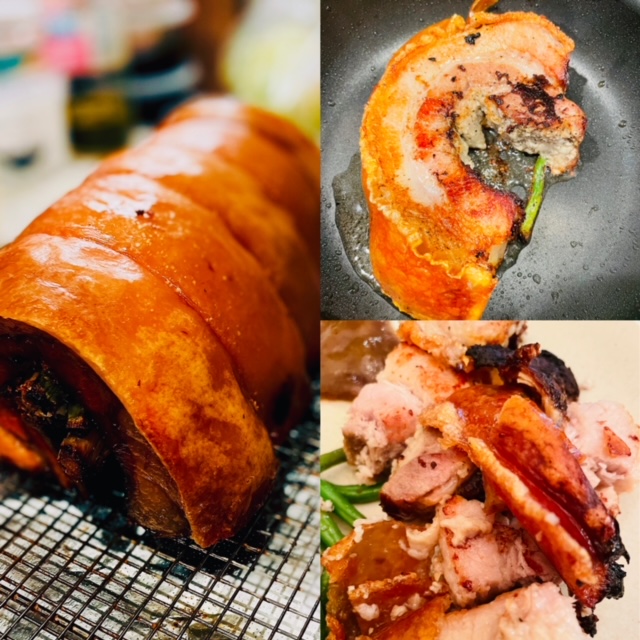
As a chef, I often give tasks to my team. A couple of months ago, I asked one of our sous chefs to prepare a Filipino dish called Lechon. It is traditionally a whole roasted pig on a spit. The most common way to do this at home is using pork belly, rolled with lemongrass and spices inside and roasted until the skin is crispy and the meat is tender. It is more complicated than it sounds, and it takes skills, time, and patience. Chef Ezekiel of Grand Central Café made this dish so perfectly that I have requested that he repeat it several times. I know that I couldn’t do it the way he did it. It was simply perfect. He accepted this challenge like a boss. He had never done it before, but just like the 13-year-old me, Chef Ezekiel took on a challenge and prepared a beautiful dish for someone scary!
We are faced with challenges all the time. Some are small, and some are life-changing. Some challenges may seem impossible to accomplish. It’s okay to be afraid at times. It’s okay to worry. It’s okay not to know what to do. Oftentimes, we succeed just by trying. Sometimes we achieve greatness, and sometimes we are defeated. But soon enough, another challenge comes up, and frequently, without us even noticing it, that last battle we fought has helped us win this one. The second time around, we have a bit more experience to help handle the stress and fears. With every challenge, we better recognize triumphs, and we learn to be a little gentler on ourselves when we fail.
Whether we’re 13, 30, or 51, life throws curveballs at us. We can choose to catch them, avoid them, or let them hit us. What’s important is making sure you’re on the field…you don’t want to miss out on the game!
I hope you get to share special meals with the humans in your life who are always there to troubleshoot problems big and small with you. I hope you continue to believe that you are capable and that you are special.
I would like to share with you two recipes from the past and the present…my version of Squid Adobo (stuffed with chorizo) and Chef Ezekiel’s Pork Belly Cebuchon. These recipes came into my life 38 years apart, but they provide inspiration to me on many levels. I hope you step up to the plate and take a shot at preparing these dishes (or ones that remind you of a “challenge accepted”) for you, for the people who have believed in you since you were 13, and the people that believe in you now.
Bon Appetit!
Chorizo-Stuffed Squid Adobo
Servings: 6 to 8
Ingredients
2 lbs. medium-sized squid or cuttlefish, cleaned, cuttlebone removed
1 lb. Mexican style chorizo, bulk (optional)
1 tablespoon canola oil
1 medium onion, diced
5 cloves of garlic, minced
2 Roma tomatoes, diced large
1/2 cup soy sauce
1/2 cup vinegar
1/2 cup water
4 oz of squid ink
1 teaspoon sugar
Salt and pepper to taste
Instructions
- Stuff each squid with about 1 oz of ground chorizo. Secure the end of the squid with a toothpick, so the filling doesn’t come out when cooking. Do not overstuff.
- Heat oil in a pan, sear each stuffed squid until brown on both sides, about 30 seconds on each side.
- Remove the seared squid from the pan and set aside.
- Add the onions and garlic on the pan and sauté for about 1 minute, until the garlic is fragrant, and the onions are soft.
- Add the tomatoes and cook for about 1 minute.
- Pour in the soy sauce, vinegar, water, ink, and sugar. Simmer for about 3 minutes until the sauce is slightly thickened.
- Add the squid back in the pan and cook for 3 minutes.
- Transfer to a serving bowl then serve.
- Eat with steam jasmine rice.
Chef tip:
- Clean the squid properly before cooking. Make sure to remove the innards and the cuttlebone on its back. Cut the tentacles just below the eyes and remove the beak from the tentacles. The beak is the hard cartilage at the base of the tentacles. Rinse the squid in cold water after removing the inedible parts.
- If you want to make this recipe without the chorizo, skip the first 3 steps.
- Small drizzle of fish sauce gives this dish that additional umami flavor. I recommend it!

Cebuchon
Ingredients
5 to 6 lbs. skin-on, boneless, pork belly
2 each lemongrass stalks
¼ cup minced garlic
2 tbsp. fresh cracked black pepper
2 tbsp. Kosher or Hawaiian sse salt
4 each stalk of scallions, whole, washed
Equipment:
Kitchen shears/knife
Butcher’s twine
Procedure:
- Cut the root of the lemon grass and scallions. Then pound lemongrass using the back of the knife, just enough to release the aroma.
- Place pork belly in a cutting board, skin side down, or meat facing up.
- Pat the belly dry with paper towels and make sure that any bones are not still attached to the meat.
- Sprinkle the salt all over the meat side of the belly. (Hawaiian sea salt would be the better choice, kosher will work as well)
- At the same time sprinkle pepper meat side up as well. (course size would be preferred)
- Place both lemongrass and scallions in the belly. (orient the pork belly with the longest side nearest to the edge of the table, and shortest on the left and right)
- With the scissors or a knife, cut about a 12 in. length of butcher’s twine. Then slide that under the pork belly around the middle area. Tie the butchers knot twice, closing the middle of the pork belly. (this is the easiest way to start the roll, you can also roll the pork belly first then make the middle knot.)
- Repeat this tying process for 4 to 5 more times, spreading the whole length of the pork belly, eventually closing the belly in on itself leaving you with a flat bottom and skin around the log.
- Place in an anti-cross contamination pan or dish where the pork can air dry inside the refrigerator for 24 hours. Keep the pork open and place in the bottom of the fridge. (this will help with the crisp of the skin)
- Pre- heat the oven at 370 degrees F. while that is going, take the pork out of the fridge and let it come to close to room temp.
- Place the pork belly on a oven rack and sheet tray, sheet pan. (a turkey pan would work too) place in the oven to cook for 3-4 hours. Check the skin every 2 hours.
- On the last hour or when the skin is golden brown, raise the temperature to 390 F to finish cooking. (be sure to rotate if your oven does not have a balanced temperature.
- Take the pork belly out and let it rest for 30 min. to 1 hour. This will help the skin to get even crispier with the help of the air.
- Cut into slices using the twine as the portions or remove the twine and chop into 1 in chunks.
- Serve with steamed white rice and a half vinegar, half soy sauce dipping sauce.
 mayetcooksdotcom
You always amazed me luv u
LikeLike